

Industry Narrative Hook: The Procurement Dilemma Facing Modern Cricket Clubs
A university athletic director sourcing kit for an 18-player squad faces a decision that extends far beyond color selection. The choice between dye-sublimated cricket uniforms and traditional cut-and-sew whites determines match-day performance, multi-season durability, and total cost of ownership across a program’s lifecycle. League organizers managing budgets across 12-15 club teams encounter a fragmented supplier landscape where garment specifications are rarely disclosed with technical precision — GSM weights, fiber blends, and stitch density are frequently omitted from vendor quotes entirely.
The operational stakes are substantial. A standard cricket match, whether a T20 fixture or a multi-day first-class contest, subjects players to sustained periods of high-intensity movement under direct sun exposure, often for six to eight hours per session. Traditional cotton-blend whites, long the default in club cricket, were engineered for aesthetic tradition rather than thermoregulation. Procurement agents who fail to distinguish between fabric construction methods routinely overpay for uniforms that degrade within a single season, while clubs that understand the underlying textile science extract three to four seasons of competitive use from a single kit investment.
This analysis maps the complete technical and operational landscape: the chemistry of sublimation dye transfer, the zonal engineering behind moisture-wicking cricket whites, comparative cost-per-wear modeling, and a structured procurement playbook for clubs evaluating custom cricket kit suppliers, including USA Teamwear’s CU-905 sublimated whites platform.
Core Conceptual Exploration: The Science Behind Sublimated Cricket Uniforms
The Chemical Mechanics of Dye Sublimation
Sublimation printing operates on a precise thermodynamic principle distinct from screen printing or heat-transfer vinyl. Solid disperse dye, printed onto transfer paper using specialized inkjet equipment, is pressed against 100% polyester fabric under a calibrated heat press operating at approximately 200°C (392°F) with 40-60 PSI of pressure for 35-55 seconds, depending on fabric weight. Under these conditions, the dye bypasses its liquid phase entirely, converting directly from a solid to a gas. This gaseous dye penetrates the open molecular pores of the polyester fiber, which expand under heat. As the fabric cools, the pores contract and seal, permanently bonding the dye within the fiber’s molecular structure rather than depositing it as a surface coating.
This distinction carries direct performance consequences. Because the dye becomes part of the fiber rather than sitting atop it, sublimated graphics exhibit zero cracking, peeling, or fading under repeated wash cycles — a structural advantage traditional screen-printed numbers and sponsor logos cannot replicate. Independent wash-durability testing typically demonstrates sublimated graphics surviving 50+ industrial wash cycles at full color saturation, whereas screen-printed vinyl numbers show measurable cracking after 15-20 cycles.
Moisture-Wicking Cricket Whites: Zonal Mesh Knit Venting
The physiological case for engineered cricket whites centers on core body temperature regulation. During sustained fielding or batting innings, the human body generates metabolic heat that must be dissipated through evaporative cooling — sweat moving from skin to fabric surface, then evaporating into ambient air. Traditional 100% cotton whites absorb sweat into the fiber itself, retaining moisture against the skin and adding measurable garment weight (up to 7% of dry weight in saturated cotton) that compounds athlete fatigue across a full day’s play.
Performance-engineered cricket uniforms address this through a hydrophobic-to-hydrophilic gradient construction: the inner fabric layer, contacting skin, uses a hydrophobic polyester weave that resists moisture absorption, pushing sweat outward through capillary action to the outer hydrophilic layer, where it spreads across a larger surface area for accelerated evaporation. This is engineered using 160-220 GSM 100% interlock polyester with four-way mechanical stretch, frequently incorporating zonal mesh knit panels at the underarm, lower back, and side-rib regions — areas identified through thermal imaging studies as primary heat-accumulation zones during athletic exertion.
Enclothed Cognition and Match-Day Psychology
Beyond thermoregulation, uniform construction influences athlete performance through enclothed cognition — the psychological framework demonstrating that the symbolic meaning and physical fit of worn garments measurably affects cognitive processing and confidence states. Research in this domain indicates that athletes wearing precisely fitted, professionally branded uniforms report elevated perceived competence and team cohesion compared to athletes in ill-fitting or generic kit. For club and university procurement agents, this translates into a tangible argument for investment in tailored sizing charts and high-fidelity sublimated branding over generic stock uniforms with applied iron-on numbers.
Fabric Construction Methods Compared
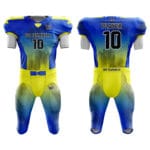
Traditional whites are typically cut-and-sew garments: fabric panels are dyed in bulk (piece-dyed) before being cut into pattern pieces and stitched together. This method limits design complexity to solid colors or simple panel-blocking, since multi-color graphics require separate fabric dyeing runs. Sublimated uniforms reverse this sequence — full-color, photographic-quality graphics are printed onto white polyester fabric stock before cutting and sewing, enabling unlimited color gradients, sponsor logo placement, and individualized name/number printing without per-unit cost escalation.
Technical Pro-Tip: Procurement agents should request a fabric GSM (grams per square meter) specification sheet from any supplier before approving a bulk order. Cricket whites below 160 GSM exhibit excessive show-through under stadium floodlighting and degrade structurally within 20-25 wash cycles; whites above 220 GSM compromise breathability and increase heat retention during multi-day matches.
Technical Comparison Table: Sublimation vs Traditional Cut-and-Sew Whites
| Specification | Sublimated Performance Whites (e.g., CU-905) | Traditional Cut-and-Sew Cotton-Blend Whites |
|---|---|---|
| Base Fabric | 100% interlock polyester, 160-220 GSM | 65/35 or 50/50 cotton-polyester blend, 200-260 GSM |
| Moisture-Wicking Rating | High (hydrophobic-hydrophilic gradient weave) | Low to moderate (cotton absorbs rather than wicks) |
| Color/Graphic Capability | Unlimited full-color gradients, photographic logos | Limited to 1-3 solid panel colors |
| Dye Permanence | Permanent fiber-bonded (gas-phase dye transfer) | Surface-dyed; prone to fading after 20-30 washes |
| Stretch Recovery | Four-way mechanical stretch, full range-of-motion retention | Minimal stretch; restricts bowling/batting biomechanics |
| Dry Time (post-wash or post-sweat) | 25-40 minutes (ambient air) | 90-150 minutes (ambient air) |
| Average Garment Weight (saturated) | 180-240g | 320-410g |
| UV Protection Factor (UPF) | UPF 30-50 (treated polyester) | UPF 15-25 (untreated cotton) |
| Sublimated Number/Name Durability | 50+ industrial wash cycles, zero cracking | 15-20 wash cycles before visible degradation |
| Per-Unit Cost (custom team order, 15+ units) | Moderate (single production run, no minimum per color) | Lower per-unit base cost, but higher add-on fees per color/logo |
| Recommended Use Case | Competitive league, university, representative-level play | Recreational or low-frequency social cricket |
The Step-by-Step Purchasing & Manufacturing Playbook
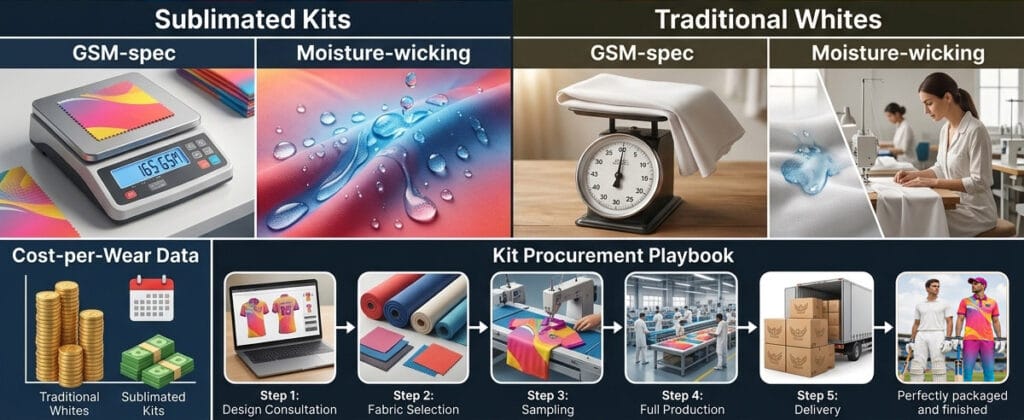
Procurement agents managing a custom cricket kit order should anticipate the following sequence, which reflects standard direct-to-factory production timelines:
- Initial Specification Brief (Day 0-1): Club submits roster size, fabric weight preference (160/180/220 GSM), garment style (full-sleeve, half-sleeve, or sleeveless), and any sponsor logo files (vector format preferred: .AI, .EPS, or high-resolution .PDF at minimum 300 DPI).
- Complimentary Mockup Design (Day 1-3): In-house design team produces digital mockups at zero cost, typically delivering 2-3 revision rounds covering color placement, zonal mesh panel positioning, and individualized name/number layout proofing.
- Sizing Chart Confirmation (Day 2-4): Club submits individual player measurements against a standardized size chart (chest, waist, sleeve length, garment length) to prevent the single most common return-driver in bulk apparel orders — incorrect fit.
- Digital Proof Sign-Off (Day 4-5): Club issues written approval on the final print-ready sublimation file before production begins; this step is non-reversible once production is triggered.
- Sublimation Printing & Fabric Cutting (Day 5-7): Heat-press sublimation transfer is executed at the production facility, followed by computer-aided pattern cutting to individual player measurements.
- Stitching & Construction QC (Day 6-8): Garments are assembled using flatlock or coverstitch seam construction to minimize chafing, followed by a three-point quality control inspection covering stitch density, color accuracy against the approved proof, and dimensional tolerance.
- Final Packaging & Dispatch (Day 8-9): Garments are individually bagged and labeled by player name/number for team-side distribution efficiency.
- Doorstep Logistics (Day 9-10): Shipment via DHL or FedEx international express, with tracking issued directly to the procurement contact; total turnaround from approved proof to doorstep delivery typically lands within the 7-10 day window.
Coaching Budget Metric: For a standard 18-player squad order, procurement agents should budget an additional 10-15% contingency above the base quote to account for mid-season roster changes (new player additions requiring individualized name/number sublimation runs outside the original bulk order).
Strategic Business Implications: ROI and Durability Standards
| Business Metric | Sublimated CU-905 Whites | Traditional Whites |
|---|---|---|
| Expected Functional Lifespan | 3-4 competitive seasons | 1-2 competitive seasons |
| Cost-Per-Wear (based on 40 wears/season) | Lower (extended lifespan amortizes initial cost) | Higher (faster replacement cycle) |
| Mid-Season Reorder Flexibility | High (digital print files retained for instant re-runs) | Low (requires new dye-lot matching, risk of color variance) |
| Sponsor Visibility Quality (logo clarity at distance) | High-definition, photographic clarity | Moderate, limited by screen-print resolution |
| Brand Consistency Across Reorders | Exact digital color matching (Pantone-referenced) | Variable (dye-lot dependent) |
| Athlete Performance Impact | Measurable reduction in perceived exertion via moisture management | Neutral to negative (added garment weight when saturated) |
| Certifications Typically Applicable | ISO, BSCI, OEKO-TEX compliant production | Varies by supplier, often undisclosed |
The cost-per-wear model is the determining variable for budget-conscious athletic directors. A traditional whites kit priced lower at initial purchase but requiring replacement after a single season generates a higher total expenditure across a three-year program cycle than a sublimated kit with a higher upfront unit cost but extended functional lifespan. League organizers managing multi-team budgets should request a three-year total cost projection from any supplier rather than evaluating quotes on a single-season basis.
Common Pitfalls to Avoid in Custom Cricket Kit Procurement
Pitfall 1 — Skipping the GSM Disclosure Request: Vendors who decline to specify fabric GSM in writing are frequently substituting lower-grade material post-quote. Procurement agents should treat GSM disclosure as a non-negotiable line item in any purchase order.
Pitfall 2 — Approving Sizing Without Individual Player Measurement: Generic S/M/L/XL sizing, rather than individualized measurement-based cutting, is the leading cause of mid-season fit complaints and unnecessary return-and-replace cycles.
Pitfall 3 — Underestimating Logo File Resolution Requirements: Submitting low-resolution raster logo files (under 150 DPI) results in pixelated sublimation output. Vector files (.AI, .EPS) eliminate this risk entirely regardless of final print size.
Pitfall 4 — Ignoring Zonal Mesh Placement in Design Mockups: Clubs that approve mockups focused solely on color and branding, without confirming mesh-panel ventilation placement, frequently receive functionally identical garments to standard whites despite paying a premium for “performance” fabric.
Pitfall 5 — Failing to Confirm Production Capacity Before Peak Season Ordering: League-wide orders submitted within 4-6 weeks of season start frequently encounter production queue delays at facilities without confirmed rapid-turnaround capacity, underscoring the importance of a guaranteed 7-10 day production window.
Comprehensive FAQ
What is the difference between sublimated and traditional cricket whites?
Sublimated cricket whites use a gas-phase dye transfer process that permanently bonds color into 100% polyester fiber, enabling unlimited graphic detail and superior moisture-wicking performance, while traditional whites are piece-dyed cotton-blend garments limited to solid colors with lower sweat-management capability.
Is sublimated fabric hotter to wear than cotton cricket whites?
No. Sublimated polyester fabric engineered with zonal mesh knit venting and a hydrophobic-hydrophilic moisture gradient actively pulls sweat away from skin for faster evaporative cooling, whereas cotton absorbs and retains moisture, increasing perceived heat and garment weight during play.
How long does custom sublimated cricket kit production take?
Standard production timelines from approved design proof to doorstep delivery typically span 7-10 days, covering sublimation printing, pattern cutting, stitching, quality control, and international express shipping.
What GSM fabric weight is best for cricket whites?
Competitive-level cricket whites generally perform best between 160-220 GSM; below 160 GSM risks excessive transparency under floodlighting, while above 220 GSM compromises breathability during extended match play.
Does sublimated printing fade after repeated washing?
No. Because sublimation dye chemically bonds within the polyester fiber rather than resting on the surface, sublimated graphics and numbers typically withstand 50 or more industrial wash cycles without cracking or fading, compared to 15-20 cycles for screen-printed alternatives.
Can sublimated cricket uniforms include individual player names and numbers without added cost per unit?
Yes. Because sublimation printing occurs digitally before fabric cutting, individualized name and number variations within a single bulk order do not require the per-unit setup fees associated with screen-printing each variation separately.
Bottom Line & Next Steps
The technical evidence is unambiguous: sublimated cricket uniforms constructed from 160-220 GSM moisture-wicking polyester with zonal mesh venting deliver measurable advantages in thermoregulation, graphic durability, and multi-season cost-per-wear economics over traditional cut-and-sew cotton-blend whites. Procurement agents evaluating custom cricket kit suppliers should require GSM disclosure, individualized sizing protocols, and vector-format logo submission as baseline requirements before approving any bulk order.
USA Teamwear LLC, operating direct-to-factory through its Sialkot, Pakistan production facility (Hash International) with USA-based coordination out of Fredericksburg, VA, offers the CU-905 sublimated cricket whites platform built to these exact specifications. Clubs, university athletic departments, and league organizers initiating a project receive complimentary mockup design from the in-house team of 20 designers, a guaranteed 7-10 day production-to-doorstep turnaround, and a 100% replacement or cash-refund guarantee backed by ISO, BSCI, and OEKO-TEX certified production standards. Procurement teams ready to request a GSM specification sheet and itemized team quote can initiate contact with USA Teamwear’s client support, available 24/7, to begin the design proof process.