
Custom Soccer Jerseys: Designing a World Cup-Inspired Kit for Grassroots Teams
World Cup energy is a marketing gift for grassroots soccer. Right now, more families and adult league players are paying attention to the sport than at almost any other point in recent memory. That attention translates into signups, sponsorships, and merchandise sales — but only if your club looks the part.
Custom soccer jerseys built with sublimation printing and high-performance athletic mesh let small clubs achieve a pro-style fit and a national-team look without a national-team budget. This guide breaks down the fabric science, printing methods, fit standards, and design strategy you need to build a bespoke football kit that rallies your squad and impresses parents, sponsors, and opponents alike. Skip to the FAQ or comparison tables if you’re short on time — but the sections in between explain the “why” behind every recommendation.
Why the World Cup Moment Matters for Your Club
Major tournaments create a predictable spike in grassroots soccer participation. Registration numbers tend to climb in the months surrounding a World Cup, and local leagues often see a wave of new players and volunteer coaches wanting to get involved. With the 2026 FIFA World Cup being hosted across the United States, Canada, and Mexico, that spike is landing close to home for North American clubs.
For club organizers and league managers, this is a narrow window. New players are choosing which club “feels” competitive. Sponsors are more receptive to soccer-branded proposals. And returning families are more willing to spend on a jersey upgrade if the timing feels relevant.
A kit refresh timed to this moment does three things:
- Signals legitimacy. A sharp, sublimated jersey tells prospective players your program is organized and serious.
- Builds identity. A custom design gives your club a visual signature that shows up in photos, social posts, and tournament sideline shots.
- Unlocks revenue. Fan-cut replica jerseys and reversible practice kits are easy upsells during a World Cup summer.
None of this works with a generic, off-the-rack jersey. It works with a kit designed the way professional and national teams design theirs — which means understanding the materials and processes behind a true custom soccer jersey.
What “Custom” Actually Means in Soccer Kit Manufacturing
Not all “custom” jerseys are equal. It helps to separate the term into three tiers, since pricing and quality vary widely between them.
| Tier | What It Means | Typical Use Case |
|---|---|---|
| Decorated stock | Blank jersey + heat-press number/logo | Rec leagues on tight budgets |
| Sublimated custom | Full-color design dyed into the fabric | Competitive clubs, travel teams |
| Fully bespoke pro-cut | Custom pattern, sublimation, and tailored fit | Elite academies, semi-pro clubs |
Grassroots and competitive youth clubs generally get the best return from sublimated custom jerseys. They deliver a professional look at a reasonable per-unit cost, especially at team-order volumes.
Sublimation Jersey Printing: The Technology Behind the Look
How Sublimation Works
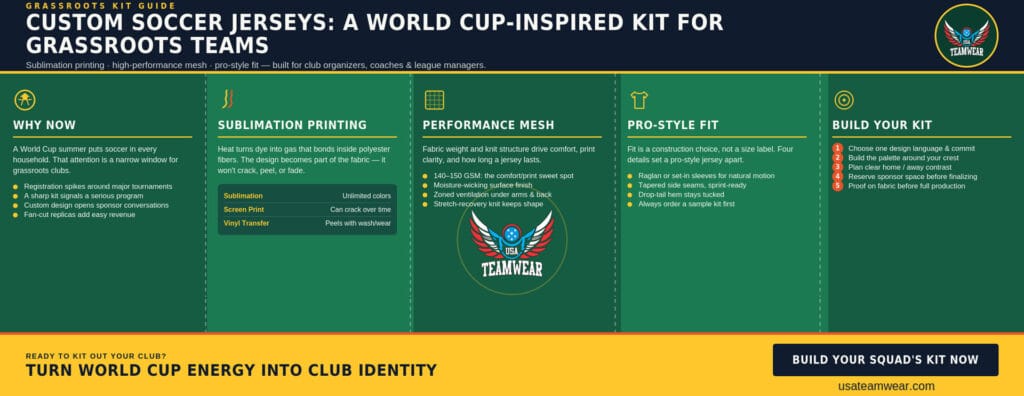
Sublimation printing is a dye-transfer process. A design is printed onto transfer paper using sublimation ink, then heat and pressure are applied to bond the paper to polyester fabric. The heat turns the dye into a gas, which permeates the fabric fibers and solidifies as it cools. The ink becomes part of the fabric rather than sitting on top of it.
This matters for soccer specifically because jerseys take a beating: sliding tackles, grass stains, constant washing, and sun exposure. A sublimated design won’t crack, peel, or fade the way a screen-printed or vinyl-pressed design can over a season.
Sublimation vs. Other Decoration Methods
| Method | Durability | Color Range | Best For | Cost at Team Volume |
|---|---|---|---|---|
| Sublimation | Excellent — dyed into fibers | Unlimited, photo-quality gradients | Full custom kits, crests, sponsor logos | Moderate |
| Screen printing | Good, can crack over time | Limited color separations | Simple logos on stock jerseys | Low |
| Heat-transfer vinyl | Fair, can peel | Limited | Player names/numbers on budget kits | Low |
| Embroidery | Excellent | Limited detail | Crests, club badges on outerwear | High |
Why Sublimation Suits World Cup-Inspired Designs
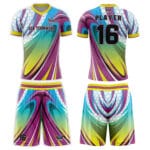
World Cup and national-team kits are known for bold, complex patterns: gradient fades, geometric motifs, and multi-color crests. Screen printing struggles with this level of detail because each color requires a separate print pass, which adds cost and weight to the fabric. Sublimation handles unlimited colors and gradients in a single process, which is exactly what’s needed to replicate that international-tournament aesthetic on a club budget.
High-Performance Athletic Mesh: What’s Actually in a Modern Jersey
The Fabric Question
“Mesh” isn’t one material — it’s a knit structure that can be built from different polyester blends and weights. The right mesh affects comfort, durability, and how well the sublimation print holds up.
Key fabric characteristics to evaluate:
- Weight (GSM). Most performance jerseys fall between 130–160 grams per square meter (GSM). Lighter fabric breathes better; heavier fabric resists show-through and holds print detail more crisply.
- Moisture-wicking finish. Polyester itself doesn’t absorb sweat, but a wicking finish pulls moisture to the fabric surface for faster evaporation.
- Knit structure. Birdseye and pique knits are common in soccer because they create air channels between the body and fabric.
- Stretch recovery. A small percentage of spandex or a stretch-knit polyester allows the jersey to move with the player and return to shape after washing.
Mesh Placement Matters
Pro-style jerseys often use zoned mesh — heavier ventilation panels under the arms and across the back, tighter knit across the chest and shoulders for print clarity and slight structure. This zoning is a detail worth requesting from your manufacturer if budget allows; it’s a visible marker of a genuinely pro-style fit rather than a generic athletic tee with a crest on it.
A Quick Fabric Comparison
| Fabric Type | Breathability | Print Clarity | Season Durability |
|---|---|---|---|
| Lightweight interlock (120–130 GSM) | High | Good | Moderate |
| Standard performance mesh (140–150 GSM) | Moderate-High | Excellent | High |
| Heavyweight pique (155–165 GSM) | Moderate | Excellent | Very High |
For most club and league orders, standard performance mesh in the 140–150 GSM range is the sweet spot between comfort and longevity.
Achieving a Pro-Style Fit
Why Fit Is a Design Decision, Not Just a Sizing Chart
A pro-style fit isn’t just “athletic cut.” It’s a set of construction choices:
- Raglan or set-in sleeves that move naturally with a throw-in or shot motion.
- Tapered side seams that follow the body without restricting sprinting.
- Drop-tail hem in the back to keep the jersey tucked during play.
- Ribbed or self-fabric collar that holds shape wash after wash.
Sizing for a Real Roster
Grassroots and youth teams have a wider range of body types than a professional squad, so fit strategy has to flex. A few practical guidelines:
- Order a size-run sample kit before committing to team sizes. Fit runs differently across manufacturers, even at the same labeled size.
- For youth teams, confirm whether sizing is based on age or height/chest measurement — age-based youth sizing varies significantly between brands.
- Offer a relaxed-fit option alongside the athletic cut for players or coaches who prefer more room; comfort supports participation retention as much as fit precision.
Fit Comparison at a Glance
| Fit Style | Movement | Look | Best For |
|---|---|---|---|
| Athletic/pro-cut | Closer to body, minimal drag | Sharp, tournament-ready | Competitive travel and club teams |
| Classic/relaxed | Looser, more airflow | Traditional | Rec leagues, older adult leagues |
| Youth-athletic | Scaled pro-cut proportions | Matches pro aesthetic | Competitive youth academies |
Designing the World Cup-Inspired Kit: A Step-by-Step Framework
Step 1: Choose a Design Language, Not Just a Color
International kits tend to draw on a handful of recognizable design languages: bold single-color fields with a contrast trim, gradient fades, geometric or cultural pattern motifs, and sash or diagonal band layouts. Pick one language and commit to it across home and away kits rather than mixing several — consistency reads as more professional than novelty.
Step 2: Build Around Your Crest
Your club crest is the anchor of the design. Sublimation allows the crest’s colors to be pulled directly into the jersey’s pattern — for example, using the crest’s secondary color as a sleeve trim or gradient base. This creates visual cohesion between badge and kit.
Step 3: Plan Home and Away Contrast
A true kit set needs enough contrast between home and away jerseys to avoid color clashes with opponents. A simple, tournament-safe approach:
- Home kit: primary club color as the dominant field.
- Away kit: white, light neutral, or an inverted color scheme.
- Alternate/third kit (optional): a bold accent color reserved for tournaments or sponsor activations.
Step 4: Decide on Sponsor and Sleeve Placement Early
If your club carries local sponsors, reserve chest or sleeve space in the design file from the start. Retrofitting sponsor logos onto a finished design usually compromises the layout.
Step 5: Proof Before You Print
Always request a digital proof and, where possible, a physical sample before full production. Colors can shift slightly between screen and sublimated fabric, and a physical sample is the only reliable way to confirm true color and fit.
Practical Example: A Sample Club Kit Build
Scenario: A U12 travel club wants a World Cup-inspired refresh for the fall season.
- Design language: Gradient fade from crest’s navy to a lighter blue across the chest.
- Fabric: 145 GSM performance mesh with underarm ventilation panels.
- Fit: Youth-athletic cut, sized by height/chest chart with a sample kit ordered first.
- Home kit: Navy-to-blue gradient, white trim, club crest centered.
- Away kit: White base, navy gradient accents on sleeves, matching crest placement.
- Sponsor space: Reserved lower-back panel for a single local sponsor logo.
- Timeline: Design proof approved six weeks before the first tournament; production and shipping scheduled with a buffer for reorders.
This kind of structured build keeps design ambition in check with realistic budget and timeline constraints — a common failure point for first-time custom kit orders.
Budgeting for a Custom Kit: What Drives Cost
Custom jersey pricing is driven by a small number of factors, and understanding them helps you negotiate and plan.
- Order volume. Per-unit cost drops significantly at higher quantities; most suppliers have tiered pricing breaks.
- Design complexity. More colors and pattern elements don’t raise cost much with sublimation, but multiple garment types (jersey, shorts, socks) each add cost individually.
- Fabric weight and finish. Heavier or specialty-finish mesh costs more per unit than standard weight.
- Add-ons. Player names, numbers, and sponsor logos are typically priced separately from the base jersey.
- Turnaround time. Rush production usually carries a premium; ordering ahead of the season avoids it.
A simple rule of thumb: lock in your roster size and design early, and order in one consolidated batch rather than several small reorders, since minimums and setup costs reset with each new production run.
Common Mistakes Grassroots Clubs Make
- Skipping the sample kit. Sizing charts vary by manufacturer; guessing sizes leads to costly reorders.
- Overcomplicating the design. Too many colors or pattern elements can look cluttered rather than professional.
- Ignoring fabric weight. Choosing the cheapest, lightest fabric to save cost often shortens jersey lifespan.
- Late sponsor logo requests. Adding a sponsor after the design is finalized can force a costly redesign.
- No color contrast plan. Failing to plan a distinct away kit can cause match-day conflicts with opposing teams.
Frequently Asked Questions
How long does a custom sublimated soccer jersey typically last?
With proper care, a quality sublimated jersey on performance mesh can last multiple seasons of regular play and washing without significant fading or cracking, since the design is dyed into the fabric rather than applied on top.
Is sublimation printing suitable for jerseys with sponsor logos and player numbers?
Yes. Sublimation can incorporate sponsor logos, player names, and numbers directly into the design file, all printed in a single process rather than as separate applications.
What’s the minimum order quantity for a custom kit?
Minimums vary by supplier and design complexity. Team-sized orders (roughly 15–25 units) are the common baseline for custom sublimated kits at most soccer apparel suppliers.
Can youth and adult teams order matching designs in different sizing systems?
Yes. A single design file can typically be produced across youth and adult size ranges, allowing a club to keep one consistent look across all age groups.
How do I care for a sublimated jersey to make it last?
Wash in cold water, avoid high-heat drying, and turn the jersey inside out before washing to reduce surface friction on the printed design.
What’s the difference between “bespoke” and “custom” in football kits?
In practice, the terms are often used interchangeably. Some suppliers reserve “bespoke” for kits with a tailored pattern or fully original construction, while “custom” more broadly covers any jersey built from a club-specific design, regardless of whether the base pattern is stock or tailored.
Final Word: Turning World Cup Energy into Club Identity
A World Cup summer gives grassroots clubs a rare marketing tailwind. Capturing it doesn’t require a professional-team budget — it requires the right combination of sublimation printing, performance mesh, and a fit that actually looks and moves like the kits players are watching on television.
Get the fabric right, get the fit right, and build a design that reflects your club’s identity rather than a generic template. That combination is what turns a jersey order into a recruiting tool, a sponsor asset, and a source of pride for every player who pulls it on.
Build Your Squad’s Kit Now → Custom Soccer Jerseys
👉 For more information from USA Teamwear before purchasing your desired custom soccer apparel, feel free to contact our support team for guidance!