

Toughness Meets Flexibility: Selecting GSM Weights and Reinforced Seams for Custom Rugby Kits
Rugby kits need two things at once: stretch and strength. Compression fabric gives players freedom to move. Heavy-duty ripstop protects against grabbing hands and hard tackles. The best custom rugby uniforms blend both. Pick fabric weight based on position. Pick seam type based on how rough your league plays. Never sacrifice fit for toughness, or toughness for fit. This guide breaks down GSM weights, seam reinforcement, and compression panels so club presidents, coaches, and equipment managers can order kits that survive a full season.
Why This Decision Matters for Your Program
A torn jersey mid-match is more than embarrassing. It stops play. It costs money. It can even lead to injury if loose fabric gets caught in a ruck. Teams that order the wrong fabric weight end up replacing kits twice a season. That eats into equipment budgets fast.
Rugby is a grabbing sport. Forwards get pulled by the collar. Backs get tackled at speed. Every position puts different stress on a jersey. That’s why “one fabric fits all” doesn’t work for serious programs.
This article compares compression-style jerseys against heavy-duty, reinforced designs. It explains GSM (grams per square meter) fabric weight in plain terms. It also covers seam construction, ripstop technology, and how to match kit choices to your team’s level of play.
What Is GSM and Why Should You Care?
GSM stands for grams per square meter. It measures how much a piece of fabric weighs. Higher GSM means thicker, heavier fabric. Lower GSM means lighter, stretchier fabric.
Think of it like comparing a t-shirt to a hoodie. A t-shirt is light and moves with you. A hoodie is heavy and tough. Rugby fabric works the same way.
Quick GSM Reference Table
| GSM Range | Feel | Best For |
|---|---|---|
| 140-160 GSM | Light, stretchy | Backs, sevens rugby, warm climates |
| 160-190 GSM | Balanced | Most club-level forwards and backs |
| 190-220 GSM | Heavy, tough | Front row, youth durability needs, cold climates |
| 220+ GSM | Maximum durability | Elite forwards, high-contact leagues |
Higher GSM fabric resists tearing. It holds up to grabbing and scrumming. But it’s also heavier and less breathable. Lower GSM fabric breathes better and stretches more. It’s lighter to wear during a full 80-minute match.
There’s no single “correct” number. The right GSM depends on position, climate, and how physical your competition is.
Compression Panels: The Case for Flexibility
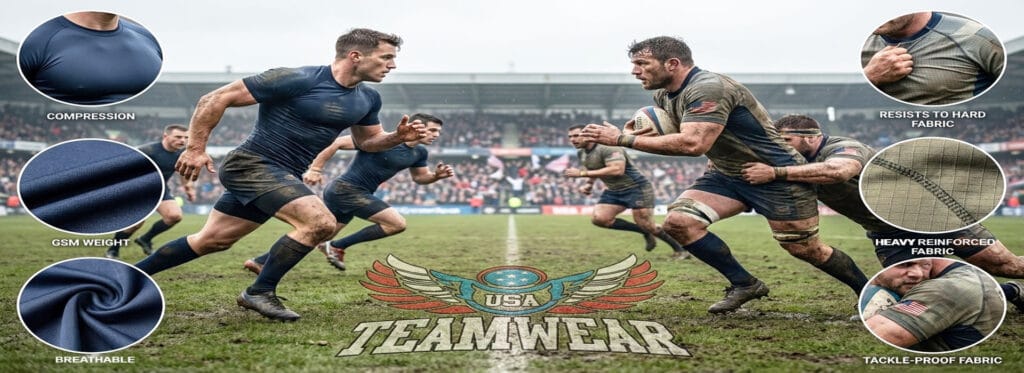
Compression fabric hugs the body. It reduces drag when an opponent tries to grab a jersey. Many modern rugby kits use compression panels in high-mobility zones like the shoulders, sides, and underarms.
Benefits of Compression Panels
- Reduces grip points. Tighter fabric gives defenders less to grab onto.
- Improves range of motion. Backs and scrum-halves need to pass, dive, and sprint without restriction.
- Supports muscles. Some players feel less fatigue with light compression support.
- Moisture management. Compression fabrics often wick sweat faster than loose-cut jerseys.
Where Compression Falls Short
Compression alone isn’t built for heavy contact. A pure compression jersey can stretch out of shape after repeated tackles. Thin compression fabric can also tear at the collar or sleeve if a defender gets a firm grip.
This is why smart kit design doesn’t choose compression or durability. It places compression fabric only where mobility matters most, and reinforces the rest.
Reinforced Ripstop Seams: The Case for Durability
Ripstop fabric uses a special weaving technique. Thicker threads are woven in a grid pattern through the fabric. If a small tear starts, the reinforced grid stops it from spreading. That’s where the name comes from; it stops rips.
Why Reinforced Seams Matter
Most jersey failures don’t happen in the middle of the fabric. They happen at the seams. Shoulder seams, side seams, and collar seams take the most pulling force during a tackle.
Flatlock stitching is the industry standard for rugby seams. It lies flat against the skin, so it won’t chafe. It’s also stronger than a standard overlock stitch used on casual t-shirts.
Double-stitched or triple-stitched seams add extra rows of thread at stress points. This is common at the collar, shoulders, and underarms, exactly where defenders grab.
Ripstop vs. Standard Weave Comparison
| Feature | Standard Weave | Ripstop Weave |
|---|---|---|
| Tear resistance | Moderate | High |
| Weight | Lighter | Slightly heavier |
| Cost | Lower | Higher |
| Best use | Light-contact leagues, training kits | Full-contact matches, front row |
A jersey built with ripstop panels and reinforced seams can survive dozens of matches without ripping at the collar. That’s a real cost saving for programs on a tight budget.
Compression vs. Durability: Head-to-Head Comparison
Here’s a direct side-by-side look at how each approach performs across the factors that matter most to team decision-makers.
| Factor | Compression-Focused Kit | Durability-Focused Kit |
|---|---|---|
| Mobility | Excellent | Good |
| Breathability | High | Moderate |
| Tackle resistance | Moderate | Excellent |
| Lifespan (matches) | 15-25 | 30-50+ |
| Best position fit | Backs, wingers, scrum-halves | Props, locks, hookers |
| Ideal GSM | 140-170 | 180-220+ |
| Price per unit | Lower | Slightly higher |
The Real Answer: You Need Both
Most experienced coaches don’t pick one side. They ask for hybrid construction. That means:
- Compression panels at the shoulders, sides, and underarms for mobility.
- High-GSM ripstop panels across the chest, back, and collar for grab resistance.
- Reinforced flatlock seams everywhere two panels meet.
This hybrid approach gives forwards the toughness they need in scrums and mauls. It gives backs the freedom to sprint and dive without feeling stiff. A well-designed custom rugby uniform blends both zones based on real match data, not guesswork.
Matching Fabric Choice to Position
Different positions face different physical demands. Here’s a simple breakdown any equipment manager can use when placing an order.
Front Row (Props and Hooker)
- Highest GSM (200+)
- Reinforced collar and shoulder seams
- Less compression, more grab-resistant panels
- Priority: surviving scrums
Second Row and Back Row (Locks and Flankers)
- Mid-to-high GSM (180-200)
- Balanced compression and ripstop zones
- Priority: durability with some mobility for lineouts and rucks
Halfbacks and Centers
- Mid GSM (160-180)
- More compression panels for passing and tackling range
- Priority: flexibility with moderate grab resistance
Wingers and Fullback
- Lower GSM (140-160)
- Maximum compression for speed
- Priority: breathability and freedom of movement
Other Factors That Affect Kit Toughness
GSM and seams matter most, but a few other details separate a cheap jersey from a tackle-proof one.
Fabric blend. Polyester-spandex blends offer the best mix of stretch and strength. Pure polyester is tougher but stiffer. Pure spandex stretches well but tears easily.
Sublimation printing. Dye-sublimated graphics are printed into the fibers, not on top. This means logos and numbers won’t crack or peel after repeated washing, unlike heat-transfer vinyl.
Collar design. A ribbed or reinforced collar resists stretching out of shape when grabbed. Loose collars are one of the most common failure points in youth and club kits.
UV and weather resistance. Outdoor leagues in sunny or wet climates should ask about UV-stable dyes and quick-dry treatments to prevent fading and mildew.
Common Mistakes Club Managers Make
- Ordering the lightest fabric to save money. This often costs more long-term through mid-season replacements.
- Using the same GSM for every position. Front row players need tougher fabric than wingers.
- Ignoring seam type. A jersey can have great fabric but still fail at a weak seam.
- Skipping a wear test. Always request a sample jersey before ordering a full team set.
- Forgetting sizing for layering. Cold-weather teams may need slightly roomier cuts for base layers underneath.
Frequently Asked Questions
What GSM is best for full-contact club rugby?
Most club teams do well with 180-200 GSM. This range balances toughness with breathability for a full 80-minute match.
Do compression jerseys tear more easily than standard jerseys?
Not necessarily. It depends on the thread quality and seam construction, not just the compression fit. A well-built compression jersey with reinforced seams can be just as durable as a looser cut.
How long should a custom rugby jersey last?
A quality jersey with reinforced seams and proper GSM should last a full season of regular matches and training, often 30 or more uses, before showing significant wear.
Can youth rugby teams use the same fabric as adult teams?
Youth teams often benefit from slightly lighter GSM for comfort and growth room, paired with reinforced seams for durability, since younger players are still learning proper tackling technique.
Is ripstop fabric heavier than regular polyester?
Slightly, yes. The reinforcing threads add a small amount of weight, but the tear resistance usually outweighs the minor weight difference for contact sports.
What’s the difference between flatlock and overlock stitching?
Flatlock stitching lies flat and resists chafing while adding strength at stress points. Overlock stitching is common on cheaper, casual apparel and isn’t built for high-contact sports.
Building Your Team’s Custom Kit
Choosing between compression and durability isn’t really a choice at all. It’s a balancing act based on position, climate, and league intensity. Forwards need higher GSM and reinforced seams. Backs need lighter, stretch-focused compression zones. Every team benefits from ripstop reinforcement at the collar and shoulders, since that’s where most tackles happen.
USA Teamwear works with club presidents, university coaches, and league equipment managers to design custom rugby uniforms that match these exact needs. From GSM selection to reinforced seam placement, USA Teamwear builds kits meant to survive a full season of hard rugby, not just look good in a photo.
A well-designed uniform protects your budget as much as it protects your players. Don’t let a torn collar or a stretched-out jersey slow down your season.
Ready to outfit your squad with gear built for real contact? Contact our sales team for an Indestructible Rugby Kit!
Explore custom rugby uniforms, reinforced ripstop panels, and high-GSM performance fabrics built specifically for club, university, and league play at USA Teamwear.