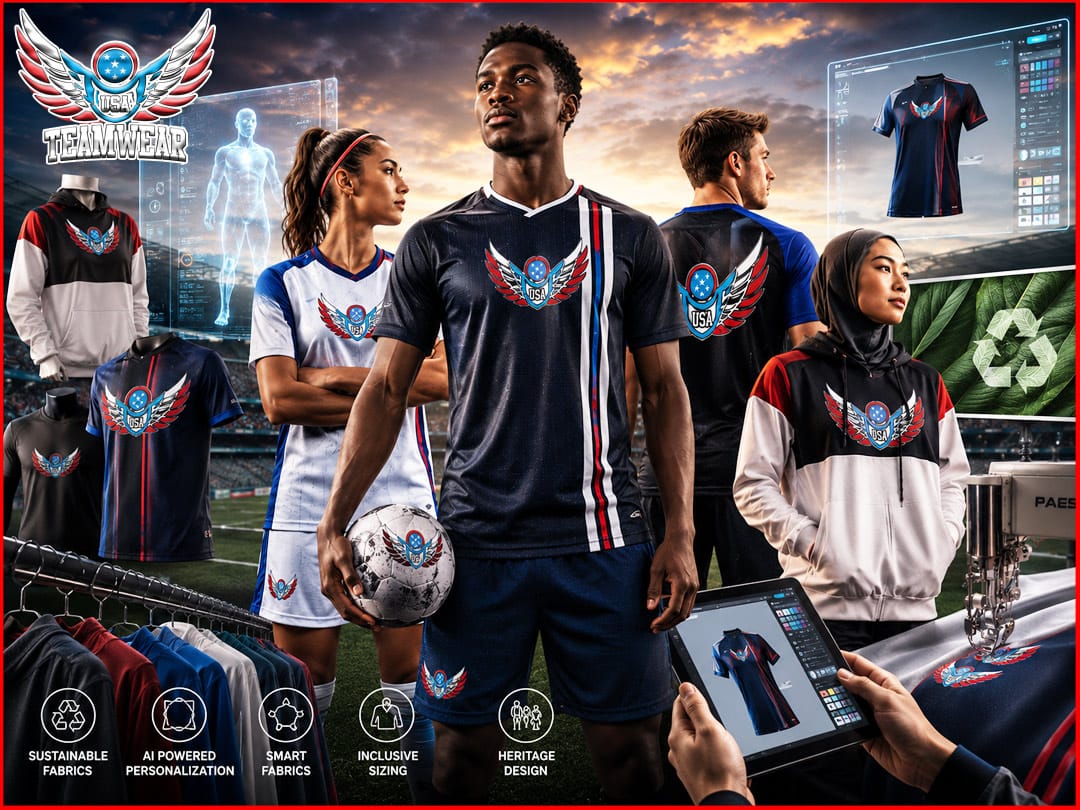

2026 Trends in Custom Sports Apparel: What’s Shaping the Future of Athletic Uniforms
The custom sports apparel industry in 2026 is not quietly evolving — it is loudly, visibly, and irreversibly transforming. Whether you are a school athletics director ordering Custom Soccer Uniforms for the fall season, a cycling club commissioning Custom Cycling Uniforms for a cross-country tour, or a lacrosse program building its brand from scratch with Custom Lacrosse Uniforms, the decisions you make this year will be shaped by six defining forces: sustainability, smart fabric technology, heritage aesthetics, inclusive sizing, lifestyle crossover appeal, and on-demand personalization powered by artificial intelligence.
If you read nothing else in this article, remember this: the teams, clubs, and organizations that align their apparel strategy with these six trends in 2026 will not just look better on the field — they will perform better, attract more sponsorship, retain athletes longer, and build a visual identity that lasts for a generation. Everything else below explains exactly how and why.
Why 2026 Is a Turning Point for Sports Apparel
Cast your mind back a decade. Custom sports kits meant picking from three template designs, choosing your colors from a swatch card, adding a logo, and waiting eight weeks for delivery. The result was acceptable. It was functional. But it was rarely exciting, rarely sustainable, and almost never truly custom in the deepest sense of the word.
Fast forward to 2026, and the landscape has changed so dramatically it would be almost unrecognizable to a coach or team manager from ten years ago. Teams ordering Rugby Uniforms can now specify the exact GSM weight of the fabric, the compression rating of individual panels, the placement of ventilation zones relative to a player’s sweat-map data, and the precise Pantone shade of every stripe — and receive production-ready samples within days, not months.
This is not just innovation for innovation’s sake. This transformation is being driven by three simultaneous pressures that are reshaping the entire sporting goods industry:
- Athletes are more informed than ever. They understand the difference between polyester blends, they know what moisture-wicking means in practice, and they have strong opinions about how their kit should look and feel.
- Environmental accountability is no longer optional. Governing bodies, sponsors, schools, and sports organizations are increasingly requiring measurable sustainability credentials from their suppliers.
- The line between performance apparel and everyday fashion has blurred almost beyond recognition. A Rash Guard worn in the surf is now just as likely to be worn on a city street. Puffer Jackets designed for sideline warmth are being worn to work. Men’s Double-Layer Shirts designed for training layering are appearing in lifestyle photography campaigns.
Against this backdrop, let’s dig into each of the six major trends reshaping custom sports apparel in 2026 — and what they mean for you, whether you’re a team buyer, a coach, an athletic director, or an independent brand looking to make your mark.
Trend 1: Sustainability Is Reshaping Every Category — and It’s No Longer a Marketing Strategy, It’s a Manufacturing Standard
Let’s be direct: sustainability in sports apparel has moved well past the point of being a buzzword on a brand’s website. In 2026, it is a hard specification that manufacturers must either meet or lose the contract.
The shift began gradually — a recycled polyester option here, a water-saving dye process there. But what we are seeing now is a wholesale reformation of how performance apparel is made from the ground up, touching every product category from Custom Soccer Uniforms to Rugby Uniforms to Rash Guards and Puffer Jackets.
Recycled Polyester: The New Industry Standard
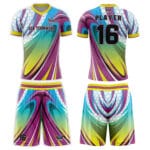
Recycled polyester — known in the trade as rPET, made primarily from post-consumer plastic bottles — has gone from a premium eco-option to the default raw material for most performance sports fabrics. In practical terms, this means the Custom Soccer Uniform your team wears next season may well be made from plastic bottles that were collected, processed, and spun into yarn.
The performance credentials of rPET have improved significantly. Early versions sometimes sacrificed hand-feel or durability. Today’s recycled polyester fabrics match or, in some cases, exceed virgin polyester in tensile strength, color retention, and moisture management — which means teams ordering Rugby Uniforms, Gaelic Uniforms, or Cricket Kits no longer have to choose between performance and environmental responsibility.
Low-Water & Waterless Dyeing Technologies
Traditional fabric dyeing is one of the most water-intensive processes in all of manufacturing. A single kilogram of dyed fabric can consume anywhere from 100 to 150 liters of water under conventional methods. New low-water dyeing technologies — including supercritical CO₂ dyeing and digital pigment printing systems — are dramatically cutting this figure, in some cases to near zero for certain fabric types.
For sublimation-printed products like Dart Jerseys, Snooker Jerseys, Archery Shirts, and Soccer Bibs, digital sublimation already operates with minimal water consumption compared to traditional screen printing. The environmental advantage here is significant and measurable.
What This Means in Practice: A Category Breakdown
| Product Category | Sustainability Feature in 2026 |
|---|---|
| Custom Soccer Uniforms | rPET fabric standard; waterless sublimation printing |
| Rugby Uniforms | Recycled polyester with reinforced recycled nylon panels |
| Rash Guards | Bio-based spandex blends; low-impact UV-treatment processes |
| Puffer Jackets | Recycled down or PrimaLoft® synthetic insulation from rPET |
| Cricket Kits | Organic cotton-poly blends for comfort-performance balance |
| Ice Hockey Jerseys | Recycled mesh panels; solvent-free adhesive bonding |
| Custom Cycling Uniforms | rPET compression fabrics with DWR (Durable Water Repellent) finish |
| Badminton Uniforms | Ultra-lightweight recycled wovens with natural antimicrobial finish |
The bottom line on sustainability: if your current kit supplier cannot give you a clear breakdown of the environmental credentials of the materials they are using, it is time to have a serious conversation — or find a supplier who can.
Trend 2: Smart Fabric Integration — The Science Behind the Jersey
If sustainability is the conscience of modern sports apparel, smart fabric technology is its brain. In 2026, the fabrics being used in elite-level and custom team apparel are doing things that would have sounded like science fiction to a sports manufacturer fifteen years ago.
Temperature Regulation: Playing Comfortable in Any Climate
Phase-change materials (PCMs) — microcapsules embedded in fabric fibers that absorb, store, and release heat in response to body temperature — are now making their way into mainstream custom team apparel. For Ice Hockey Jerseys, where players transition between extreme cold ice surfaces and warm locker rooms repeatedly throughout a game, this technology is genuinely game-changing. For American Football Uniforms worn in everything from August pre-season heat to December playoff cold, the ability of a fabric to actively buffer the microclimate around a player’s body is a measurable performance advantage.
Anti-Odor Silver-Ion Threads: The End of the Post-Match Locker Room Problem
Every athlete knows it. Every coach ignores it. Every team parent quietly wishes someone would address it. The post-match smell issue is real, and in 2026, it has a proper fabric-level solution.
Silver-ion thread technology — where microscopic silver particles are permanently bonded to yarn fibers — disrupts the bacterial growth cycle that causes odor. Unlike topical antimicrobial sprays or wash treatments that fade with repeated laundering, silver-ion integration is permanent at the fiber level. This technology is now being specified in Custom Cycling Uniforms (where long-distance riders wear the same kit for extended hours), Cricket Kits (multi-day test match formats), Custom Basketball Uniforms (high-sweat-rate indoor sport), and increasingly in Rash Guards used in water sports where post-session bacterial growth is accelerated by moisture retention.
Micro-Ventilation Engineering: Precision Airflow Where You Need It
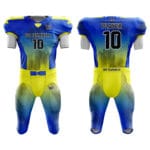
Laser-cut micro-perforations and 3D knit ventilation zones are being mapped to sport-specific sweat-zone data — areas of the body that generate the most heat and moisture during typical sport-specific movement patterns. The result is a Custom Lacrosse Uniforms with ventilation panels precisely where a lacrosse player’s body runs hottest during sprinting and checking movements. An American Football Uniform with airflow zones that correspond to the trapped heat areas under shoulder pad contact points.
Smart Fabric Adoption by Sport
- Ice Hockey Jerseys: PCM temperature regulation, moisture transport away from the body in high-exertion shifts
- Custom Cycling Uniforms: Aerodynamic compression panels, silver-ion anti-odor, micro-perforation at thigh and lumbar zones
- Cricket Kits: UV-protection woven fabrics rated UPF 50+, moisture management panels for fielding positions
- American Football Uniforms: Impact-resistant mesh, heat-mapped ventilation, anti-abrasion reinforcement at high-contact zones
- Netball Shirts: 4-way stretch micro-knit with integrated bra support channels
- Shooting Shirts: Anti-static fabrics for indoor arena environments, minimal seam construction for shooting arm mobility
Trend 3: Retro & Heritage Aesthetics — Because Classic Never Goes Out of Style
Here is something interesting happening in the middle of all this technological revolution: athletes and teams are simultaneously looking backward. The heritage aesthetic — vintage-inspired designs, classic typography, old-school color blocking, throwback silhouettes — is one of the strongest visual trends in custom sports apparel in 2026.
And the reason makes complete sense when you think about it. Technology is making fabrics smarter. Sustainability is making materials more responsible. But aesthetics are cyclical, and in a world of digital-everything and AI-generated design, there is something deeply appealing about the timeless, the handcrafted-feeling, the classic.
Where Heritage Design is Landing Hardest
Baseball Uniforms have always carried deep aesthetic heritage — the pinstripes, the flannel-inspired textures, the serif numbering fonts. In 2026, teams are leaning into this heritage rather than away from it, commissioning Baseball Uniforms with intentional vintage colorways, distressed logo treatments, and old-school piping details — all executed in modern performance fabrics that the original uniform makers of the 1920s could never have imagined.
Gaelic Uniforms are experiencing a renaissance of traditional county color heritage. GAA clubs worldwide are commissioning kits that honor the visual history of their county’s colors and crests — bold hoops, traditional sash designs, county typography — executed with modern sublimation precision and rPET sustainability credentials.
Snooker Jerseys and Dart Jerseys have an interesting relationship with heritage design. These are sports with strong working-class, pub-culture roots — and their visual identity has always reflected that: sponsor patches, bold colors, strong typography. In 2026, both sports are seeing a wave of premium custom jersey designs that lean into that heritage with a self-aware, elevated execution.
Archery Shirts are incorporating traditional motifs — archery target imagery, arrow graphic elements, medieval tournament-inspired design details — giving precision sport athletes a visual identity that references the ancient roots of their discipline.
The Design Formula for Heritage Done Right in 2026
| Design Element | Heritage Approach | Modern Execution |
|---|---|---|
| Color Palette | Classic team/county/country colors | Precisely matched Pantone codes, dye-sublimation accuracy |
| Typography | Serif fonts, varsity lettering, hand-lettered feel | Vector precision, consistent across all kit items |
| Graphics | Crests, shields, mascots, vintage logos | High-resolution sublimation, unlimited color |
| Silhouette | Classic cuts, traditional collar styles | Modern performance fabric construction |
| Finishing | Patch-feel details, distressed effects | Digital printing techniques that replicate texture |
The key insight here is that heritage aesthetics and technical performance are no longer in tension. You can have a Custom Soccer Uniform that looks like it was designed in 1975 and performs like it was engineered in 2026. That combination is exactly what many teams and clubs are choosing.
Trend 4: Gender-Inclusive & Body-Positive Sizing — Representation That Fits Every Athlete
This is perhaps the most important cultural shift in the custom sports apparel industry in 2026, and it is one that has been a long time coming.
For most of the history of team sports apparel, the industry operated on a simple and deeply flawed assumption: that athletic bodies conform to a narrow range of sizes and shapes, and that a standard XS-to-3XL grading run in a single silhouette would adequately serve everyone. The reality, of course, has always been vastly different — and the consequences of that mismatch have been real and human.
Athletes who could not find a Custom Basketball Uniform that fit properly. Female rugby players being handed oversized Rugby Uniforms designed for male bodies. Non-binary athletes who felt invisible in apparel systems that operated strictly in binary gender categories. Larger athletes in sports like netball or badminton wearing ill-fitting Netball Shirts or Badminton Uniforms that restricted movement and undermined confidence.
In 2026, the industry is actively correcting this — and not in a tokenistic way. The change is structural.
What Gender-Inclusive Sizing Actually Means in Practice
Extended and Diversified Size Grading: Leading custom apparel manufacturers are now producing size runs from XXS to 6XL with proportionally graded patterns — meaning an XL isn’t just a scaled-up M, but a garment whose proportions are recalculated for that size’s typical body geometry. This applies across Shooting Shirts, Men’s Double Layer Shirts, Custom Basketball Uniforms, and every other category.
Female-Specific and Gender-Neutral Pattern Blocks: Rather than offering a single unisex pattern that compromises for everyone, forward-thinking manufacturers now offer sport-specific pattern blocks designed specifically for female athletes, alongside truly gender-neutral options. Netball Shirts, for instance, are being engineered with torso-to-hip ratios, shoulder width distributions, and integrated support structures that reflect the actual bodies of female netball players — not a modified male pattern.
Badminton Uniforms and Inclusive Design: Badminton’s global player base is extraordinarily diverse in body type, age, and gender — from junior club players to senior veterans to para-athletes. Badminton Uniforms in 2026 are being designed with this diversity explicitly in mind: adjustable waistband systems, stretch panels that accommodate a wider range of body shapes, and collar and sleeve designs that are flattering across different body types.
The Business Case for Inclusive Sizing
Beyond the obvious ethical imperative, inclusive sizing makes clear commercial sense:
- Teams that can outfit every player in a properly fitting kit report higher morale and stronger team identity
- Clubs with inclusive sizing options attract a broader membership base
- Organizations with body-positive apparel policies are increasingly preferred by sponsors with diversity and inclusion mandates
- Resale and replacement orders are higher when athletes are genuinely happy with how their kit fits and feels
Trend 5: The Rise of Crossover & Lifestyle Apparel — When the Training Kit Becomes the Wardrobe
One of the most commercially significant trends in 2026 is the accelerating crossover between performance sports apparel and everyday lifestyle clothing. This is not new — the athleisure wave has been building for years — but in 2026 it has reached a new level of sophistication and intentionality.
The Products Leading the Crossover
Rash Guards are perhaps the most dramatic crossover success story. Originally a niche product for surfers and BJJ athletes, the rash guard has become a mainstream lifestyle garment. In 2026, custom Rash Guards are being ordered not just by swim teams and combat sports clubs, but by yoga studios, beach volleyball communities, open-water swimming groups, and lifestyle brands that want a premium, body-conscious garment with genuine performance credentials. The crossover has elevated the design expectations significantly — lifestyle consumers want Rash Guards that look as good on an Instagram post as they perform in the water.
Men Double Layer Shirts — designed originally as a performance training layer that could be worn independently or under a heavier top — have found an enormous lifestyle following. The combination of a base-layer inner and a woven or mesh outer in a single garment hits a sweet spot between performance function and casual style that resonates strongly outside the gym.
Puffer Jackets have long straddled the line between athletic and lifestyle, but custom Puffer Jackets in 2026 are being designed with this dual identity explicitly in mind. Teams ordering custom Puffer Jackets for sideline warmth now frequently choose designs that their athletes will genuinely want to wear off the pitch — which means the jacket doubles as brand ambassador every time an athlete wears it in public.
Archery Shirts and Custom Lacrosse Uniforms are finding unexpected lifestyle audiences through the growing interest in traditional and heritage sports among younger demographics. The clean, graphic aesthetic of a well-designed Archery Shirt or the bold performance look of a Custom Lacrosse Uniform translates well into streetwear contexts.
Why This Matters for Custom Apparel Buyers
| Buyer Type | Opportunity |
|---|---|
| Sports clubs & teams | Kit becomes visible brand promotion beyond the pitch |
| Schools & academies | Students wear training apparel voluntarily, extending brand reach |
| Corporate sponsors | Logo visibility in everyday lifestyle settings, not just game day |
| Independent sports brands | Lifestyle crossover doubles the addressable market |
| Community sports organizations | Apparel builds community identity beyond match days |
The practical implication: when commissioning custom apparel in 2026, buyers should think beyond match-day function and consider how the garment will perform as a lifestyle piece. The best custom kits in 2026 are ones that athletes genuinely want to wear all the time — and that visibility is worth real commercial and community value.
Trend 6: Personalization Technology & On-Demand Production — The Era of Truly Bespoke at Scale
We have saved the most transformative trend for last, and it ties together every other trend discussed above. The convergence of AI-driven design tools, digital pattern platforms, and on-demand production capability is fundamentally changing what “custom” means — and making it accessible at a price point and speed that simply was not possible even three years ago.
AI-Driven Design Tools: From Blank Canvas to Production-Ready in Hours
The traditional process for designing a custom kit involved briefing a graphic designer, reviewing multiple concept rounds, getting vector artwork approved, adapting it to technical templates, and submitting for production — a process that could take weeks and cost significant fees before a single garment was made.
AI-powered design platforms have compressed this process dramatically. A team manager can now input their colors, upload their logo, specify their sport (say, Soccer Bibs for training or a full match set of Custom Soccer Uniforms), choose a design style (modern geometric, heritage classic, minimal, bold), and receive multiple photorealistic rendered concepts within minutes. Human designers then refine the chosen direction — the AI handles the volume of initial exploration, the human handles the judgment and nuance.
This same workflow is being applied across every product category: Shooting Shirts, Puffer Jackets, Custom Lacrosse Uniforms, Ice Hockey Jerseys, Dart Jerseys, Snooker Jerseys — the AI design layer makes the initial creative process dramatically faster and more accessible for buyers without a design background.
Digital Pattern Customization: Every Size, Every Variation, Perfectly
One of the most technically complex aspects of producing custom apparel at scale has always been grading patterns across size ranges and managing the variability of individual customization (names, numbers, positions). Digital pattern systems now handle this with a precision and speed that eliminates the traditional trade-off between customization depth and production efficiency.
For a club ordering a full squad of Custom Basketball Uniforms with 15 different player names and numbers across 5 different size variants, a digital pattern system can generate every individual cut file automatically — perfectly sized, perfectly positioned, perfectly consistent across the entire order. The same applies to Rugby Uniforms with sponsor logos, Badminton Uniforms with player identifiers, or Gaelic Uniforms with county and club markings.
On-Demand Production: The End of Minimum Orders as a Barrier
Perhaps the most democratizing development in the custom apparel space in 2026 is the continued reduction of minimum order quantities (MOQs) — the minimum number of units a supplier will produce in a single run. Historically, MOQs were a significant barrier for smaller clubs and organizations. A school cricket team of 12 players could struggle to meet a 50-unit MOQ for Cricket Kits. A small archery club of 8 members couldn’t economically justify ordering custom Archery Shirts.
On-demand production systems — combining digital cutting, automated assembly, and agile finishing — are bringing MOQs down to levels that genuinely serve small sports communities. In 2026, credible custom apparel manufacturers can produce runs as small as 6-10 units of fully custom Netball Shirts, Rash Guards, or Shooting Shirts at per-unit prices that are commercially viable for the buyer.
The Technology Stack Behind 2026 Custom Production
Design Layer:        AI-assisted concept generation → Human design refinement
Pattern Layer:       Digital grading → Automated per-player file generation
Material Layer:      Sustainable rPET fabric stock → Smart fabric integration
Production Layer:    Digital cutting → Sublimation printing → Automated assembly
Quality Layer:       AI visual inspection → Human QC check → Size verification
Delivery Layer:      On-demand fulfillment → Direct-to-team shipping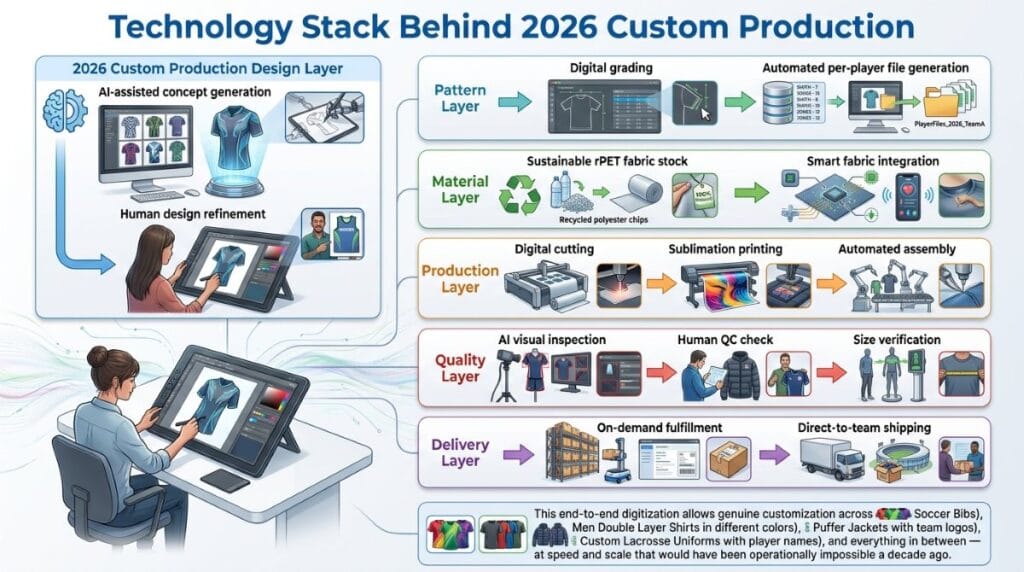
This end-to-end digitization is what allows a manufacturer to offer genuine customization — across Soccer Bibs, Men Double Layer Shirts, Puffer Jackets, Custom Lacrosse Uniforms, and everything in between — at speed and scale that would have been operationally impossible a decade ago.
How USA Teamwear Is Positioned in This 2026 Landscape
It would be difficult to write an article about the transformation of custom sports apparel manufacturing without acknowledging the supply-side story — specifically, where in the world these garments are actually being made and by whom.
USA Teamwear operates with a production unit based in Pakistan — one of the world’s most established and technically sophisticated textile and sportswear manufacturing regions, with a heritage in performance apparel production that spans decades. This combination of American market focus and Pakistani manufacturing excellence positions the brand at an interesting intersection: the quality standards and trend responsiveness that US teams, schools, and sports organizations demand, delivered at price points that reflect genuine manufacturing efficiency rather than inflated middleman margins.
The product range covers the full spectrum discussed throughout this article — from Custom Soccer Uniforms and Rugby Uniforms to Snooker Jerseys, Dart Jerseys, Archery Shirts, and Ice Hockey Jerseys — giving buyers across every sport category a single trusted source for their entire apparel program. The “reasonable price” positioning is not marketing language — it is a structural advantage of combining skilled manufacturing capacity with a direct-to-buyer model that eliminates unnecessary cost layers.
For US-based clubs, schools, academies, and independent sports organizations trying to navigate the 2026 custom apparel landscape, this manufacturing model offers a compelling answer to one of the perennial questions in team kit procurement: how do we get genuinely high-quality, fully custom apparel without the premium price tag that usually comes with it?
A Buyer’s Checklist for 2026 Custom Apparel Orders
Whether you’re ordering Custom Basketball Uniforms for a high school team or commissioning a full range of Custom Cycling Uniforms for a cycling club, use this checklist to ensure your order reflects 2026 best practices:
Sustainability:
- Are fabrics rPET or other recycled/sustainable materials?
- Is the dyeing process low-water or waterless (sublimation)?
- Can the supplier provide environmental credentials for materials used?
Performance:
- Does the fabric specification match the demands of the sport?
- Are ventilation, compression, and moisture management zones correctly placed?
- For long-duration sports, is anti-odor technology included?
Sizing & Inclusion:
- Does the size run extend to the full range needed for your squad?
- Are sport-specific pattern blocks available for female athletes?
- Can individual fit adjustments be accommodated?
Design:
- Does the design system accommodate both modern and heritage aesthetics?
- Are AI design tools available to accelerate the concept phase?
- Can the design be consistently applied across all kit components?
Production:
- What is the MOQ, and does it fit your squad size?
- What is the turnaround time from design approval to delivery?
- Can individual player customization (names, numbers) be handled within the order?
Lifestyle Crossover:
- Will training garments like Rash Guards, Puffer Jackets, and Men Double Layer Shirts be worn beyond training?
- Is the design strong enough to work as a lifestyle/brand piece?
FAQ: Custom Sports Apparel in 2026
Q: What is the most sustainable fabric option for custom team uniforms in 2026?
A: Recycled polyester (rPET) is currently the most widely available and cost-effective sustainable option for performance sports apparel. It is now being used across Custom Soccer Uniforms, Rugby Uniforms, Rash Guards, Cricket Kits, and more, with performance characteristics matching or exceeding virgin polyester.
Q: How small an order can I place for fully custom apparel?
A: With modern on-demand production systems, credible manufacturers can now produce fully custom runs of as few as 6–10 units for products like Netball Shirts, Shooting Shirts, Soccer Bibs, or Archery Shirts at commercially reasonable per-unit prices.
Q: How long does the custom design process take with AI tools?
A: Initial concept generation using AI design platforms can now be completed within hours. A full design-to-production-ready process — including human refinement, approval, and technical file preparation — typically takes 3–5 business days for most products, from Dart Jerseys to Custom Lacrosse Uniforms.
Q: Are heritage/retro designs compatible with modern performance fabrics?
A: Absolutely. Modern dye-sublimation printing can reproduce virtually any visual design — including vintage typography, distressed effects, traditional county colors, and classic silhouettes — on high-performance rPET fabrics. Your Baseball Uniform can look 1940s and perform 2026.
Q: Can the same supplier handle multiple different sports kit categories?
A: Yes — and this is increasingly the preferred approach for schools, multi-sport clubs, and academies. A supplier who can deliver Custom Soccer Uniforms, Custom Basketball Uniforms, Badminton Uniforms, Cricket Kits, Ice Hockey Jerseys, and Puffer Jackets from a single production source offers significant advantages in consistency, cost, and logistics management.
Q: What is the difference between gender-specific and gender-neutral pattern blocks?
A: Gender-specific pattern blocks are designed around the typical proportional differences of male or female bodies (torso length, shoulder width, hip-to-waist ratio). Gender-neutral blocks are designed to fit comfortably across a range of body types without being optimized for either. In 2026, leading manufacturers offer all three options — male-specific, female-specific, and gender-neutral — across most product categories including Custom Basketball Uniforms, Netball Shirts, and Badminton Uniforms.
Q: Is smart fabric technology affordable for club-level orders?
A: Increasingly, yes. While premium smart fabric technologies like PCM temperature regulation remain at a higher price point, silver-ion anti-odor threads and micro-ventilation designs are now accessible at club-level MOQs and price points for products like Custom Cycling Uniforms, Rash Guards, and Cricket Kits.
The Future of Custom Sports Apparel Is Already Here
The six trends explored in this article — sustainability, smart fabric integration, heritage aesthetics, inclusive sizing, lifestyle crossover, and AI-powered personalization — are not distant forecasts. They are active, right now, in 2026, reshaping how custom sports apparel is designed, manufactured, and experienced by athletes at every level.
The teams and organizations that embrace these trends are not just getting better-looking kits. They are getting apparel that performs more intelligently, represents their values more authentically, fits their athletes more accurately, and extends their brand presence far beyond the pitch, the court, or the field.
Whether you need Custom Soccer Uniforms for a youth academy, Puffer Jackets for a coaching staff, Rash Guards for a water polo program, Shooting Shirts for a basketball team, or Snooker Jerseys and Dart Jerseys for a precision sports club — the 2026 custom apparel market offers options that are better, smarter, more inclusive, and more accessible than at any previous point in the industry’s history.
The question is no longer whether to invest in quality custom apparel. The question is simply: are you ready to order?
For inquiries about custom apparel across all sports categories, USA Teamwear offers a full product range manufactured to 2026 performance and sustainability standards, delivered to teams across the United States at competitive pricing.